

Traditional smuggling (II)
The oldest backpacks were made of sackcloth which was very resistant. Later, cloth backpacks were replaced by laminated plastic sacks which sealed hermetically and could be used as floats to cross the river. The backpack was fastened to the body with shoulder straps and to reduce the risk of cuts from the straps on the shoulders and torso, rubber pads were worn in front of the shoulders.
The backpack usually consisted in two complementary but separate pieces: the «fiador» (the guarantor) and the load. The fiador was a small backpack, a kind of bag which was placed on top of the large backpack. The fiador was fixed to the smuggler´s body with its own straps so that, when he released the main load, the fiador stayed on his back. The fiador was used to carry food for the journey and sometimes to bring back three or four kilos of coffee hastily rescued when fleeing from a police raid.
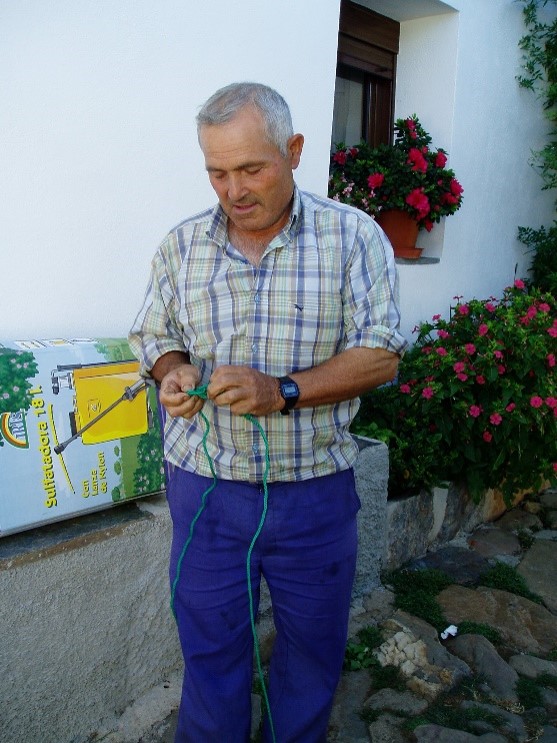
In the original and unreleased video which now follows, Juan Cepa Velo, from Jola, a farmstead in Valencia de Alcántara, shows us in detail how to prepare a smuggler´s backpack. What is more, he eloquently narrates episodes of traditional smuggling in that part of the interior border, sometimes as a witness and sometimes as the protagonist. The video illustrates in an exemplary manner what life on the border and beyond was like.