

July / August 2026
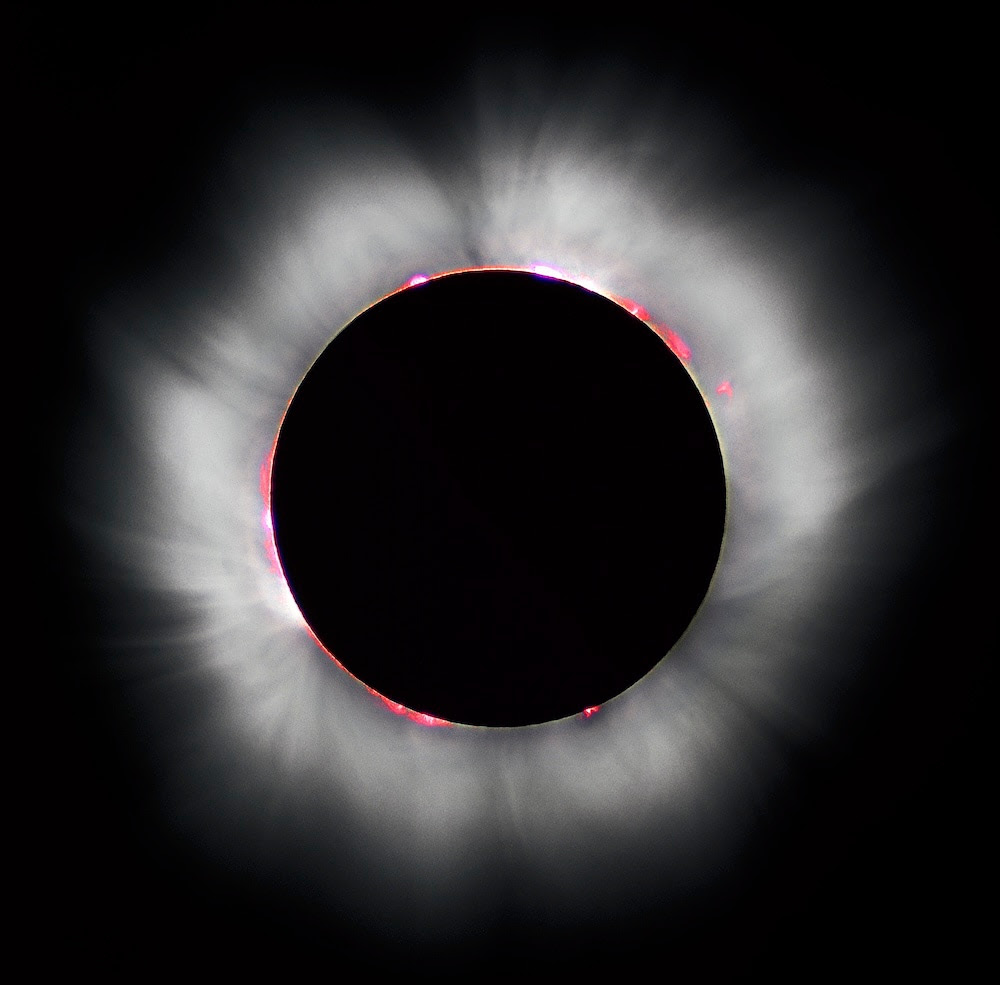 1999. Photograph of the corona (in white) and prominences (in red) emerging from the solar surface. It was taken by Luc Viatour (https://Lucnix.be) from France on the occasion of the total solar eclipse of August 11, 1999 © Creative Commons BY-SA 3.0. [Click on the image to view without the caption.]
Total solar eclipses: from science to tourism
Throughout history, total solar eclipses have not only given rise to false narratives, legends, and myths, but have also influenced kings and rulers and, on occasion, have been associated with historical events, allowing them to be dated or given special significance. Furthermore, in the last two centuries, thanks to scientific and technological advances and the great development of transportation and communications, eclipses have provided an ever-increasing understanding of our nearest star, the sun, and have allowed millions of people to enjoy this phenomenon.
Solar eclipses, and especially the unexpected and astonishing total eclipses, are usually described in ancient chronicles in such a vague, confused, or even legendary way that modern attempts to identify them are often fruitless. It was only from the Hellenistic period onward that it became possible to predict that a solar eclipse would occur and that it would be total. However, the imprecise understanding of the moon’s movement made it difficult to determine where the eclipse could be observed as total, a circumstance that meant this phenomenon continued to surprise those who witnessed it, whether they enjoyed it or, more commonly, feared it.
The earliest descriptions of solar eclipses in medieval Europe are usually very brief and sometimes link them to misfortunes such as plague, earthquakes, the death of emperors, and attempts on the lives of popes. Some preachers even considered them a cause of moral degradation: «The most shameful vices soon arose: incest, banditry, the blind struggle of passions, theft, and adultery» (Raoul Glaber, ca. 985-1047, from his work Five Books of Stories in relation to the eclipse of the year 1033). Given their rarity and unpredictability, each new eclipse continued to provoke fear and perpetuate the old superstitions associated with them.
At the beginning of the second millennium, some chronicles recount the peaceful contemplation of the eclipse and the starry daytime sky visible during totality by ordinary people, who already understood it to be a natural phenomenon and not an omen of misfortune and adversity. Nevertheless, even in the 15th century, on the occasion of a total eclipse seen in Salamanca, there are accounts of some people’s fear, who sought refuge in churches.
In the 18th century, it finally became possible to predict eclipses with considerable accuracy and map the narrow path where a total eclipse would be visible. To improve one of these maps, public participation was sought: Edmond Halley encouraged those within or near the path of totality he had calculated to inform him afterward whether they had witnessed the total eclipse and, if so, how long it had lasted. Dozens of accounts of observations of some of the eclipses of that century were published in magazines and books.
Throughout the 18th century, it was still rare for someone to travel to see a total eclipse, despite increasingly accurate predictions about where totality would be visible. In contrast, throughout the 19th century, a growing number of people traveled to remote locations to enjoy the spectacle. Indeed, improvements in observational instruments, greater ease of transportation (railways, steamships), and a rising interest in the scientific study of the sun led to the first expeditions of astronomers to the area where a total eclipse could be observed. Moreover, the observation of the 1842 total eclipse in Europe interested many educated people or those simply drawn to the curious phenomenon, some of whom later sent accounts of their observations to professionals like François Arago, who compiled, compared, and extensively commented on them. Several of these observers had traveled from their homes to the path of totality: among them were doctors, pharmacists, monks, university and military school professors, soldiers, sailors, travelers, writers, and ordinary people. The twenty thousand inhabitants of the French city of Perpignan gathered on the terraces, ramparts and outer mounds to enjoy the unusual phenomenon, which had already become a popular spectacle.
The daily press played an increasingly decisive role in encouraging public participation in the enjoyment of eclipses and everything related to them when they occurred in a populated and developed country. Such was the case with the total eclipses visible in Spain in 1900 and 1905. Daily reports detailed the progress in setting up temporary observatories in various locations across the peninsula, the arrival of eminent foreign astronomers, and the reactions and cooperation of the authorities. Many people occasionally traveled on foot, by train, bus, or private means to witness the preparations. The foreign astronomers were surprised by the friendly cooperation of the authorities and the curiosity of numerous polite citizens, which forced them to revise the unfavorable prejudices they had brought to Spain. On the day of the eclipse, thousands of travelers journeyed in overcrowded trains to the locations where the totality phase could be observed.
In recent years, the number of people traveling to enjoy a total solar eclipse has grown to millions, provided it occurs in suitable locations. The almost universal accessibility of private transportation and the significant reduction in flight prices, thanks to economy class, make reaching the chosen destinations possible. The near-universal availability of smartphones, which allow users to photograph, film, and instantly share their experiences, has also increased interest in experiencing the unique and awe-inspiring sight of a total solar eclipse. Millions of people witnessed the totality phases of the 2017 and 2024 eclipses, visible in North America, and the same will presumably happen with the upcoming total eclipses in August 2026 and August 2027. Although the observed duration of totality may be only one or a few minutes, the impression it leaves on those who witness it will be indelible.
Pere Planesas Bigas, now retired, worked as an astrophysics researcher at the National Astronomical Observatory of Spain, the California Institute of Technology (Caltech), in USA, and the European Southern Observatory (ESO) in Chile. Planesas has contributed to the Virtual Museum of Human Ecology with the Works of the month Measuring time in Antiquity (February 2024) and, in collaboration with Carlos Varea, The life cycle and learning in an 18th century Work in the Prado Museum (September 2025).
Further reading:
Planesas, P. 2005. Eclipses de sol. El eclipse anular de sol del 3 de octubre de 2005 en España, ed. Centro Nacional de Información Geográfica (CNIG).
Planesas, P. 2026. Eclipses totales de sol. Historia, relatos y controversias, available only on Amazon.
Various authors. 2025. Eclipses de sol. Los eclipses “españoles” de 2026, 2027 y 2028, ed. Centro Nacional de Información Geográfica (CNIG).
Various authors. 2026. Eclipses. El sol y sus eclipses en la ciencia, la historia y las artes, ed. Centro Nacional de Información Geográfica (CNIG).