

May 2025
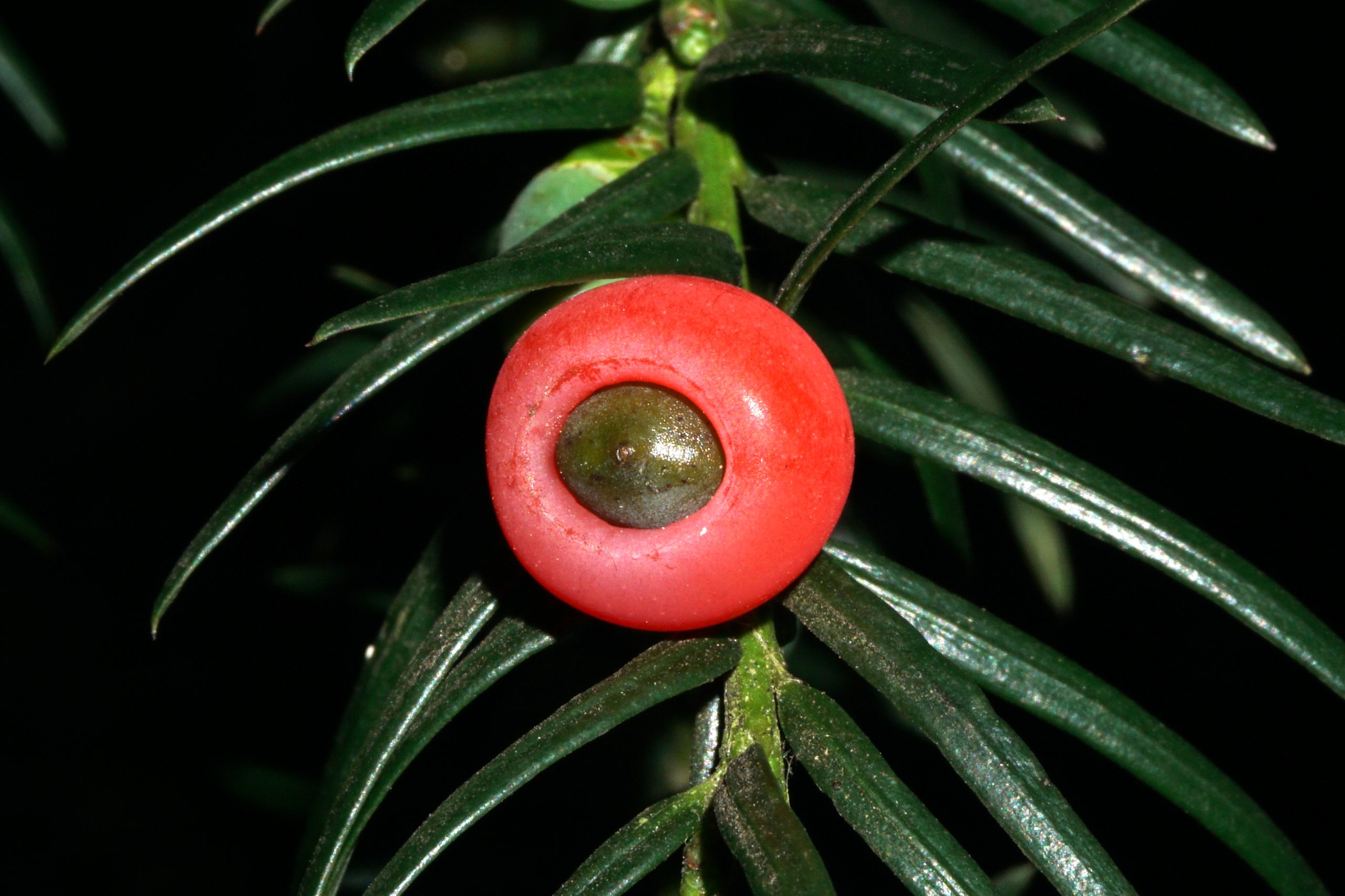 2014. Leaves, aril and seeds. 'Parque de El Retiro', Madrid (Spain). 2014. Photo: Jose Borrell Brito © Jose Borrell Brito
The common yew, an example of an urban tree with a tradition of use and exploitation
Many of the trees found in our cities represent species which have traditionally been used for very different purposes.
In the streets, parks, squares and other public spaces we can find both indigenous and non-native trees which have traditionally been exploited for their medicinal or cosmetic properties. One example is the lime tree (Tilia platyphyllos), whose flowers are drunk as infusions with sedative and antispasmodic effects, or the walnut tree (Juglans regia), with astringent leaves which aid digestion and are used to fight diabetes.
Some trees have been used as a source of food for both people and livestock. This is the case of the olive tree (Olea europaea), from which we get olives and oil. Also, the holm oak (Quercus ilex), whose acorns have traditionally fed livestock. Another example is the almond tree (Prunus dulcis), which produces almonds that are often used in confectionery.
Other trees have been used for building, woodwork or crafts. Among them is the holly tree (Ilex aquifolium), whose hard wood was used to make tools and farm implements or the stone pine tree (Pinus pinea), frequently used by carpenters. Some species also stand out for being good fuel. For example, the holm oak which is a source of firewood and charcoal.
Finally, many trees have a ritual, symbolic, religious or magical meaning in different cultures like the cypress (Cupressus sempervirens), which is traditionally associated with cemeteries; laurel (Laurus nobilis), whose leaves were used in ancient times to make crowns to honour heroes and victors; or the elm tree (Ulmus minor), which has, for centuries, been a meeting point in squares and villages.
In fact, many of the plants used in the gardening sector are species which were grown in both rural and urban settings as they provided a food complement (fruit trees like figs, almonds and walnuts) or were used as medicine (many aromatic plants grown like an open air chemist´s near the orchards).
Nowadays, we appreciate urban trees for their ornamental role, as regulators of temperature and as places to get together, but we have, on the whole, lost the functional perspective and bond which originally linked trees to human settlements.
One example is the common yew tree (Taxus baccata), a conifer in the Taxaceae family, which has traditionally been used for its medicinal properties, the quality of its wood and because many symbolic properties have been attributed to it. In the case of the city of Madrid, for example, we can find yew trees of a large size in many parks (such as El Retiro park, Parque del Oeste…) either in the form of hedges or scattered across fields and green areas.
The yew is an evergreen tree, though it sometimes grows in the shape of a large bush. It can grow up to 10-15 metres in height and has a conical or rounded top. Its leaves are narrow and long (1-3 centimetres). They have a smooth edge and are dark green on top and a lighter green on the underside. They are aligned in two orderly rows on either side of the branches, forming a kind of plane.
Male and female flowers grow on different trees. Its fruit is small, a few millimetres across, and bears a seed surrounded by a fleshy scale of a bright red colour, called the aril, from which the tip of the seed protrudes slightly (as can be seen in the photo which illustrates this Work of the month).
The common yew grows very slowly and this slow growth is precisely one of the reasons why its wood has been so highly valued since ancient times, as it is both flexible and resistant.
It is a native species and is found in much of Europe, northern Africa and western Asia. In the Iberian Peninsula it is more frequent in the northern half, while in the south it is mostly found in mountainous areas. It grows at altitudes of between 500 and 2,000 metres, usually in shady places. It needs a lot of moisture and can withstand cold climates, although late frosts can damage it. The tree can grow on a variety of terrains.
It is also grown in gardens, usually as a single tree but, less frequently, also as hedges. There are many varieties of different shapes and sizes.
The yew has many different uses. One of its active ingredients, paclitaxel, is used in anti-carcinogenic treatment. We should point out that in Taxus baccata this compound is found mainly in the branches and needles, so it is possible to extract it without killing the tree (unlike its cousin Taxus brevifolia: until the molecule was synthesised, its forest mass was in danger from felling as the active principle in this species is distributed all over the tree).
The wood of the yew tree is highly valued for its durability and flexibility. It was used for making spears, bows and arrow (and even sarcophagi). It is also used in different kinds of woodwork, lathe work and handicrafts.
It is believed to have magical properties, such as being a lightning conductor if a few branches are hung on the front door of a house. It is also said that sleeping under a yew tree can cause death. It was traditionally planted in cemeteries, churchyards and places of ritual significance. The expression «tirar los tejos» (to flirt with) seems to be linked to the old habit of throwing its seeds to attract attention…
We should highlight that it is a very poisonous plant. The only non-toxic part is the aril which covers the seed. It is inadvisable to consume even that in case you also swallow the seed.
We believe that contributing to the recognition of our cities’ natural heritage, boosting appreciation of these trees and awareness of their role in urban sustainability will create collective benefits, strengthening the link between the citizens and nature while promoting an urban culture which is more respectful and healthier. The yew tree is a good example.
José Borrell Brito has a degree in Biology from the Universidad Autónoma de Madrid (Spain) and is a member of Grupo Heliconia, an expert on environmental education and in developing training and dissemination projects. He has contributed to the Virtual Museum of Human Ecology with the Works of the month Birds diversity, indicator of quality of life in cities (January 2019) and Urban wild plants: not really «weeds» (June 2024). He is the author of the guide and poster Hierbas silvestres urbanas de Madrid: una aproximación cultural (Urban wild plants in Madrid: a cultural approach) all edited by the Asociación para el Estudio de la Ecología Humana together with the Grupo Heliconia collective thanks to funding from Fundación Asisa.