

November 2026
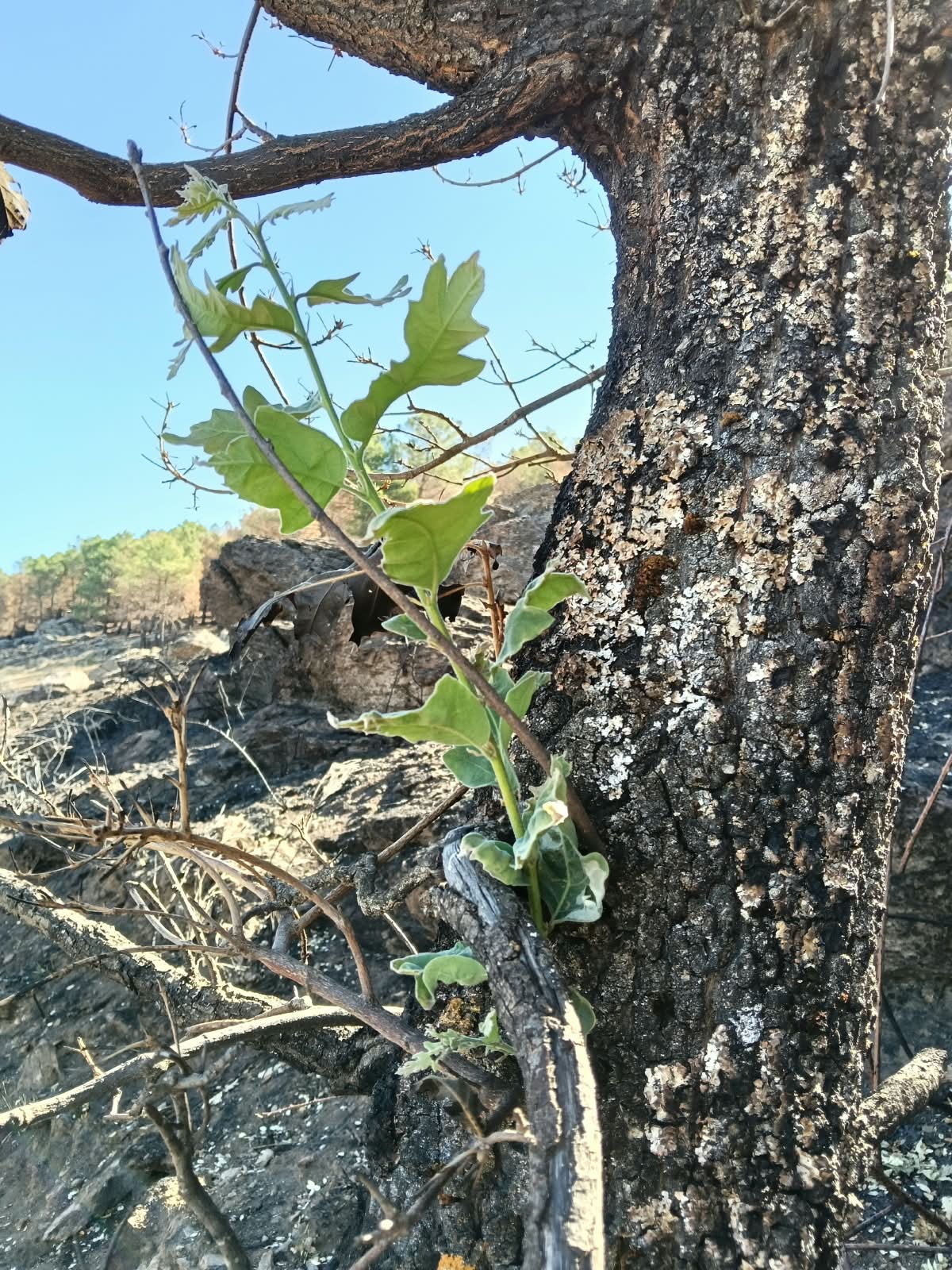 2026. Burnt holm oak in Loyozuela (Madrid, Spain) during the wildfire in the middle of July 2026. The photo was taken towards the end of September. Despite the fire and the extremely dry summer, the holm oak shows after a short time a surprising capacity for natural regeneration. Photo: Simón Cortés (ARBA) © Simón Cortés (ARBA). [Click on the image to view without the caption.]
Managing burnt timber after a forest fire
Wildfires have destroyed a total of 1,283,185 hectares over the past decade. A large part of the areas burnt corresponds to woodland, and the northwest quadrant of the Iberian Peninsula has been most affected with Ourense, León and Zamora at the top of the list. For the past decade, three years in particular show a large number of large fires (those over 500 hectares): 2022, with 50, 2025, with 24 and finally, 2026, with 38. These wildfires, known as «sixth generation», are extremely difficult to put out with current available means. Because of the conditions of temperature, humidity and wind in which they develop, and also because they generate their own climate dynamic due to the huge quantity of heat they let off, they cannot be extinguished and managing them gives priority to protecting rural or urban surroundings rather than the forest mass which burns irremediably.
Once the fires are over, politicians promise rapid measures to compensate the damage done. The first measure applied by the Autonomous Communities in Spain —whose remit it is— is to pass decrees allowing the burnt wood to be cut down, both on public and on private land. The timber sold creates immediate income for compensation or reparation for the loss of livestock, crops or tourism. However, scientific evidence is clear: leaving the burnt wood where it is helps accelerate the recovery of the ecosystem and favours natural regeneration of the countryside, which makes one think that these exceptional actions are more about economic interests than scientific criteria.
Over the past years, there have been many cases of natural regeneration of burnt hillsides, undertaking policies of non-aggressive intervention for the burnt wood. In the terrible wildfire in Riba de Saelices, Guadalajara, July 2005, 13,000 hectares burnt and eleven people died (members of the fire-fighting teams). Twenty years on, there are wide areas where natural regeneration has been a success, led by native species which regrow shortly after the fire has been put out. In other areas, however, the burnt wood was removed and pines were planted exclusively, creating a completely different profile to the flora of the areas of natural regeneration. Other factors such as increased shepherding, diversification of species when replanting or creating clearings in the forest to create pastures also help the recovery of burnt woodland. In recent fires —such as those in Lozoyuela (July 2026) and El Berrueco (July 2019), both in the Community of Madrid— we can see natural regeneration with a variety of native species including Pinus pinaster.
Wood consists of many of the chemical elements needed for life (nitrogen, phosphorus, potassium, calcium, magnesium, iron, manganese, boron, etc.) and in the shape of trunks, branches and roots makes up about 95% of a tree’s biomass. Decomposition and the slow absorption of these minerals by the soil are beneficial for the burnt land as they progressively provide essential elements for the new seedlings. Moreover, they are a direct source of food for many organisms such as fungi and insects, which in turn sustain other animals like birds, reptiles and mammals. The dead wood is part of the food chain and feeds the other forest dwellers and is therefore an essential component of the biodiversity of our woodland and hillsides.
Felling and extraction of burnt wood is carried out using clear-felling, which means eliminating all plants from the area. This worsens the effect of the fire as it delays natural regeneration and decreases future biodiversity, reducing the available organic matter and increasing soil erosion and degradation. The use of heavy machinery, the opening up of new tracks through the forest and the preparation of the terrain all significantly increase the processes of water and mechanical erosion, favouring the loss of topsoil layers and laying bare deeper layers with abundant minerals but no humus, which compromises the ecosystem’s capacity for ecological recovery.
On the other hand, the first rainy season after the fire acts as an amplifying factor for these impacts, speeding up the movement of sediment. Fallen logs act as a natural barrier which slows down the flow of surface rainwater, thus improving the capacity for soil infiltration and refilling local aquifers.
This is how burnt trunks, both standing and fallen, help to retain the soil, ashes and leaves, preventing the wind and the rain from dragging away nutrients and preventing wind and water erosion. The treetops of burnt trunks offer shade to the undergrowth, which helps to moderate ground temperature and to reduce the evaporation of moisture, so benefitting growing species. Likewise, the burnt trunks reduce the speed and impact of raindrops, and this considerably reduces soil erosion after the fire and helps maintain base humidity, which is essential for the growth of new seedlings.
Many seeds are adapted to fire as they need its high temperature to germinate, otherwise they would remain latent. This phenomenon is known as serotiny or «heat-induced germination». The underground parts (roots and rhizomes) of many plants which survive fires contain dormant buds. These wait for favourable conditions, such as the first rain after the fire, to regrow powerfully. Trampling and compacting or de-layering of the soil due to heavy machinery are harmful, as destroy or remove these buds and seeds which are ready to regenerate. On the other hand, burnt trunks are perforated by woodpeckers and other species to make nests and refuges and are also useful as perches and lookout points. The birds which use them contribute to seed dispersal which leads to a fast regeneration of the soil.
Burnt wood is a basic pillar for the recovery of life in affected regions. It is a primary food source for many detritivores (they feed on dead matter) including xylophage beetles (they feed on wood), termites and fly and moth larvae. The abundance of insects in the wood attracts many species of insectivorous birds who find an important food source in the burnt forests.
The fallen and charred trunks provide refuge and a stable microclimate. Beneath them, or inside the rotting wood, amphibians, reptiles, small mammals and uncountable invertebrates make their home.
In conclusion, it is better not to remove burnt trunks, unless they are an imminent hazard for people, houses or tracks. We should simply act in emergency cases to control erosion with barriers and brushwood fascines. Under no circumstances should we use heavy machinery to avoid compacting the ground, altering the hydrological regime, damaging the native seed bank and regrowth but also to protect animal shelters. We should not undertake short-term replanting or forest restoration. We should not scatter straw or other extraneous matter, to avoid the risk of introducing exotic or invasive species which could damage the local ecosystem. And finally, wait for a year after the fire to evaluate natural regeneration, the seed bank and the capacity to regrow before making any long-term plans of action.
Víctor Cuevas, bachelor in education and master’s degree in Psychopedagogy, retired educational counselor, is a member of ARBA, Asociación para la recuperación del bosque autóctono (Association for the recovery of native forests), an entity which works since 1986 to protect and recover native forests and landscapes. ARBA has a total of 35 groups all over Spain, which work independently but share goals. Recently, ARBA founded the Plataforma ecologista madrileña (Madrid ecologist platform) together with other organisations that work for the protection of the land in the Community of Madrid.
Further reading
Caballero L. 2022. La madera muerta no es basura: por qué retirarla perjudica el bosque. The Conversation.
EpDATA. 2026. Incendios forestales en datos, estadísticas y cifras. EpData.
Ministerio de Medio Am../../../../Plantillas%20personalizadas%20de%20Office/EPDATA.%202026.%20Incendios%20forestales%20en%20datos,%20estad%C3%ADsticas%20y%20cifras.biente, Medio Rural y Marino. 2008. Técnicas de preparación del suelo para repoblaciones forestales en ambientes áridos y semiáridos. Ministerio de Medio Ambiente, Medio Rural y Marino, Gobierno de España.
Ministerio para la Transición Ecológica y Reto Demográfico. Varios años, Anuarios de estadística forestal. Ministerio para la Transición Ecológica y Reto Demográfico. Gobierno de España.
Ortega MA. 2026. Consecuencias de extraer los árboles tras un incendio. Reforesta.
Plataforma Ecologista Madrileña. 2026. ARBA ante la retirada de los árboles quemados después de un incendio. Plataforma Ecologista Madrileña.
Vieira D, Girona-García A, Kastridis A, Martins M. 2026. A post-fire management strategy for the EU. Fire Ecology: 22, 63.
VV AA. 2018. Guía de actuaciones en una zona quemada. Sociedade Galega de Historial Natural.