

June 2026
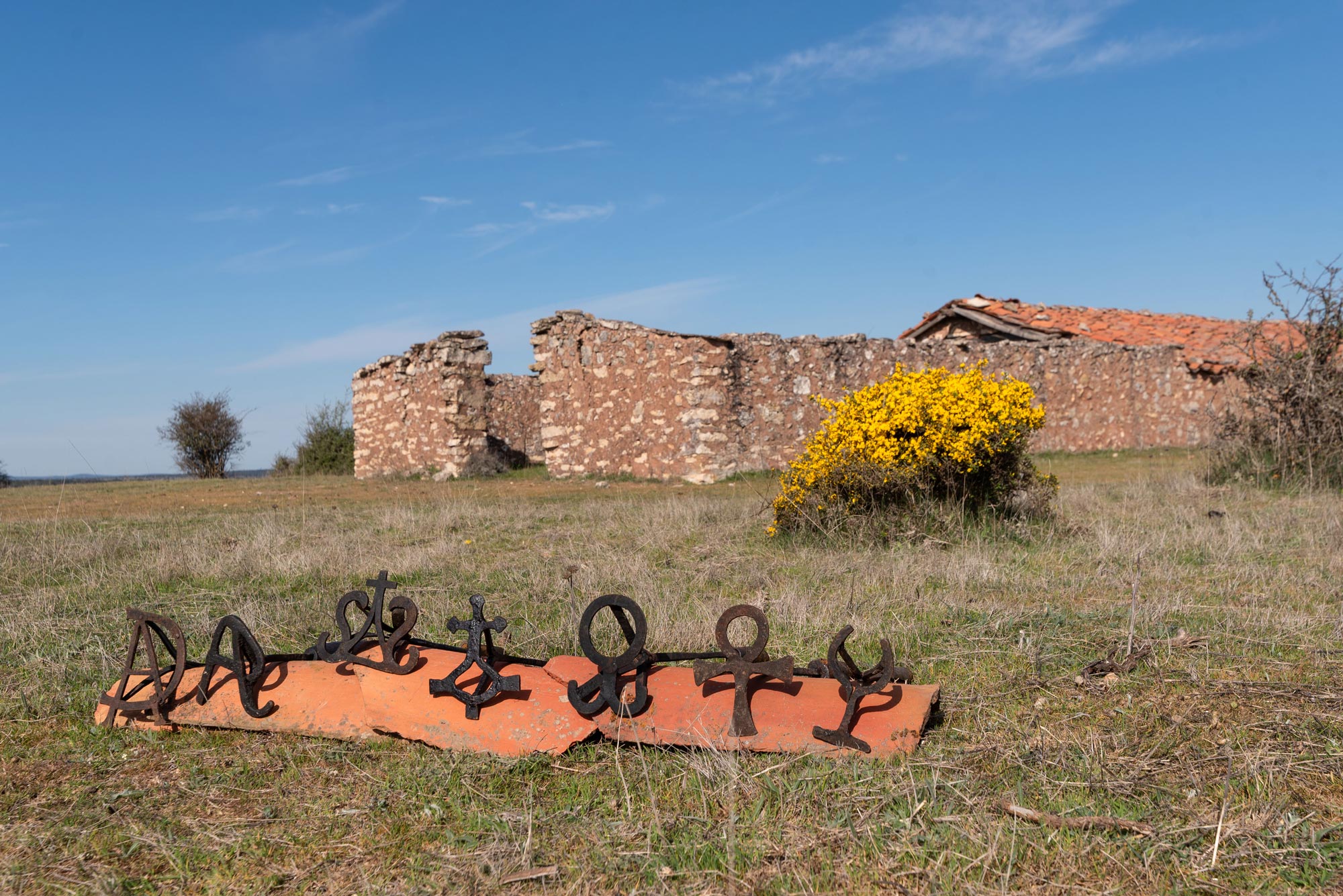 2026. Collection of livestock marking irons ('empegas'), and in the background, a traditional sheepfold (paridera) in Alcolea del Pinar (Guadalajara, Spain). Different types of marking irons can be appreciated, ranging from the owner's initials (left) to irons with crosses (centre) and other symbols (right). On the doors and walls of the sheepfolds, it is common to find, alongside other engravings, the names and signatures of former owners. Collection of marking irons from the ‘Casa Museo Máximo Rojo’. Photo: Jesús Carrizo Martín © ‘Casa Museo Máximo Rojo’ [Click on the image to view without the caption.]
Livestock marking irons and tool marks in the Highlands of Guadalajara (Spain)
For centuries, and until the 1960s, rain-fed agriculture and extensive livestock farming were the primary livelihoods of rural society in the highlands of Guadalajara. Agriculture concentrates its activities in very specific periods, such as sowing and harvesting, but leaves large gaps in the calendar. Livestock farming complements agriculture well and, in the highland areas, extensive sheep farming was the best alternative. Maintaining small flocks allowed the farming population to have a nutritional and economic supplement to agriculture, and most farmers kept small flock.
The whole family participated in the care of the flock. Boys and girls often took the sheep or lambs out to graze, and their mothers made use of the wool by making mattresses or spinning and weaving during the long winter hours, by the fireside or chatting with neighbours. The sheep were not milked, and each family had one or several goats. Some went out with the sheep and others in the communal herd (dula) cared for by a goatherd.
The livestock was kept in sheepfolds (parideras), low stone and wood constructions where the sheep were penned. They consisted of an enclosed barn and an exterior corral. Each livestock owner had one or several in different areas of the village. The flocks in the village were numerous but small in size, as evidenced by the fact that in Alcolea del Pinar there are more than 50 sheepfolds in some 2,000 hectares. Where in past times there were 2,000 to 4,000 sheep, today barely one flock of 800 head remains.
The system for recognising the animals of each flock was marking. As sheep must be shorn every year, this could not be done with fire-branding as with cattle and equids; instead, pitch marks were used. Each livestock owner, or family, had their own mark which they stamped on the ribs of the sheep using an iron called a marking iron (empega) that was impregnated with hot pitch, an operation that had to be repeated every year after shearing.
The marking irons consist of an iron with a wooden handle ending in a letter or sign. Marks of various types existed; the most frequent are a simple initial of the owner’s name or surname, but others show more complex signs formed by several letters. Religious symbols such as crosses are also frequent, as well as other more abstract ones that, in some cases, remind us of Egyptian gods. The main function of these marks is to recognise livestock ownership, although some authors also attribute protective or amulet properties to these symbols, considering them older than those using initials.
The ethnographic collection of the Casa Museo Máximo Rojo, in Alcolea del Pinar (Guadalajara, Spain), has 14 different marking irons from the area, although the former owners are unknown. In most cases, the ideogram has an approximate size of 10 by 10 centimetres, but there are two with a much smaller size. These were probably used to mark objects or to make indelible fire-brands on the forehead or horns of the animals.
The use of marks was not limited to the identification of livestock but also served to mark tools such as axes, hoes, and even keys. Until recently, communal village works were carried out through the so-called «community tasks» (hacenderas), which the Town Council convened and in which residents participated and shared work and tools; marking them prevented confusion. There were also specific marks to identify loaves of bread when they were baked in communal ovens. Sometimes they were marked with a knife, and other times the mark engraved on a piece of wood was stamped like a seal.
The implements, bridles (cabezadas), and collars (collerones) of the draft animals, basically mules, were often identified with the owner’s initial, passing from one animal to another, but also from fathers to sons.
In the same way, and surely for the same reason, it is common to find the owner’s name engraved on the doors of the sheepfolds along with other marks and signs. Thus, ownership of the asset is reclaimed—already known by everyone—but perpetuated for future generations.
Was this custom merely a way of identifying property or also a way of having a sense of belonging to a family or a house, as happened in the Navarrese and Aragonese Pyrenees and even on the French side? Village inhabitants have always been protective of property, which was handed down from parents to children and which, like surnames, gave a sense of belonging to the family. Local areas have names, traditional toponyms that are being lost, and the plots or sheepfolds receive the name of the owner («cerrada del Andrés», «paridera del Tío Pascual», «Majada de Los García», etc.). Names that, like the marks and surnames, are transmitted from generation to generation.
In addition to the village where one lived, the family was the core reference point, and the question to a stranger remains the same: «And which family are you from?». The names of the first-born were repeated generation after generation, and even a nickname could be inherited. The family was the reference point, and all these symbols helped reinforce the sense of belonging and the unity of the group in difficult times when collaboration between village inhabitants was essential. Given that marriages often occurred between neighbours of the same village, all families ended up being related, creating a strongly cohesive social network.
The loss of population, the disappearance of livestock farming, and the forgetting of toponyms and customs go hand in hand. New generations have no attachment to the land or the traditions of their elders, driven by new technologies that are often incompatible with rural life. The current inhabitants of small villages, many of them immigrants from other cultures and digital nomads, do not allow for the maintenance of this knowledge; instead, they turn villages into small cities. Local ethnographic museums are the last refuge, acting as genetic banks to maintain knowledge of the local culture and the sense of belonging to a community.
Jesús Carrizo Martín, with degrees in Biology and Veterinary Medicine from the Complutense University of Madrid (Spain), currently presides over the Alcolea del Pinar Cultural Association (ASCUA), which manages the activity of the Casa Museo Máximo Rojo in this town.
Further Reading:
Ariznabarreta Zubero A. 1991. La marca ganadera y su utilización como signo de vinculación entre la casa y su sepultura (El Pueyo de Jaca, Valle de Tena). Kobie. Antropología cultural, 5: 139-148.
Orduña Portús PM, Pérez Artuch AM. 2021. El marcado de ganado ovino roncalés: análisis de un discurso etnológico e ideográfico. Munibe Antropologia-Arkeologia, 72: 219-237.
Sardaña J, René R. 2009. Señales y marcas de propiedad del ganado en el Valle de Broto (Huesca). Geórgica: revista del espacio rural, 13: 39-61.