

September 2026
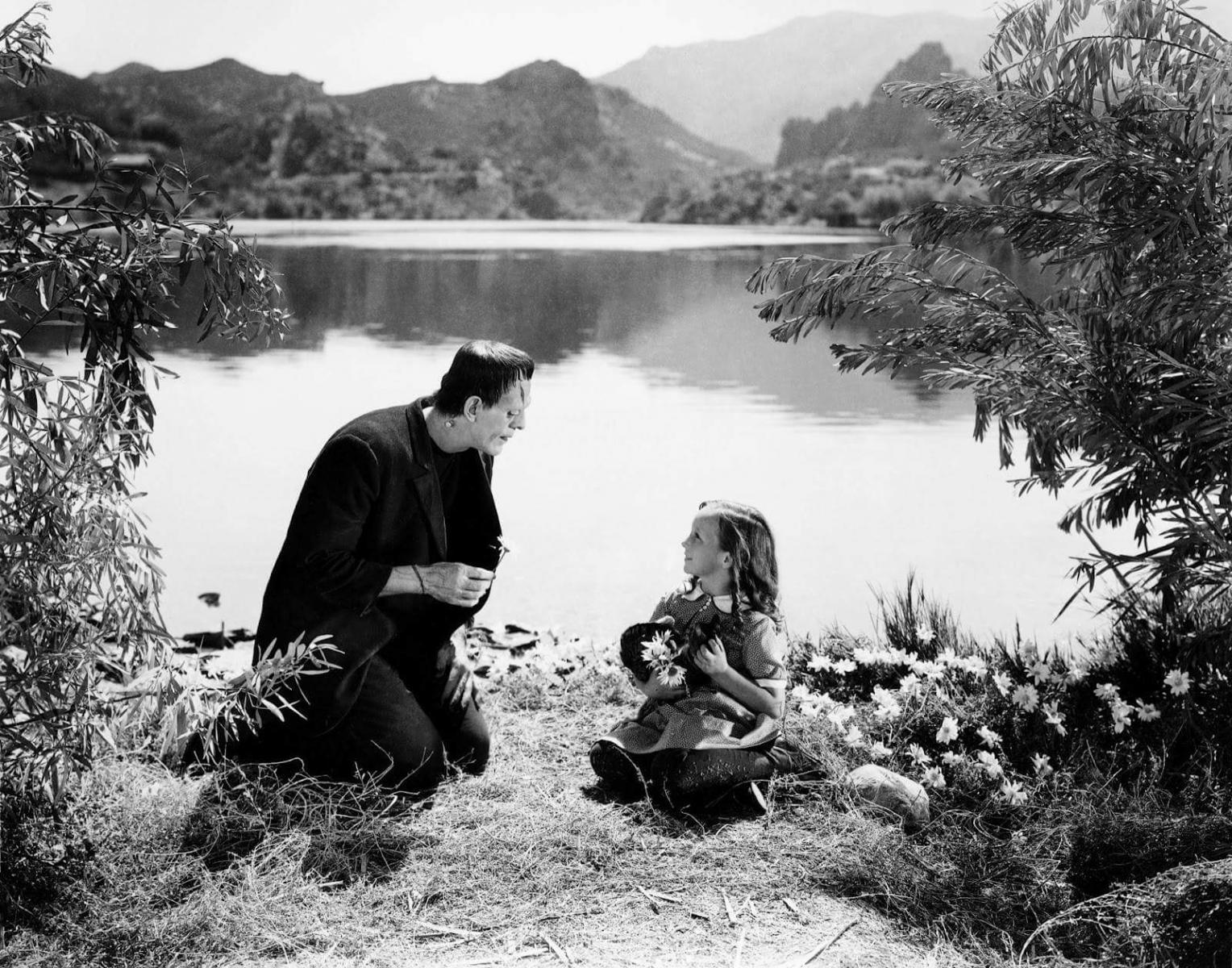 1931. Boris Karloff and Marilyn Harris in a frame from the film 'Doctor Frankenstein', directed by James Whale in 1931, two equally helpless beings © 1931 Universal Pictures. [Click on the image to view without the caption.]
Frankenstein and earthly ethics
As we know, one of the unconfirmed hypotheses on the origin of the killer virus which blighted our planet in 2020 locates it in a biochemical laboratory in the Chinese city of Wuhan, whence the virus escaped by accident while research was being carried out. For decades, science has been manipulating all kinds of viruses for medical reasons but with potential military and terrorist use.
At the beginning of August 2026, the creation of 16 new viruses was announced, using Artificial Intelligence (AI) models, viruses which neither God nor Nature would have thought of. The idea is to combat bacteria whose increasing resistance to antibiotics puts human life at risk. The problem is that to achieve this feat, scientists at the Arc Institute have had to break the basic rules of genetic inheritance, resorting to a protein which is alien to our line of evolution. Will it turn out well or badly? As author Marta Peirano says in her article Dieciséis virus sintéticos (Sixteen synthetic viruses), «you don’t need to know Young Frankenstein by heart to realise that a small change in the natural order of things can have unforeseen results».
Mary Shelley was born in 1796, daughter of a pioneer of feminism and an enlightened intellectual, she was married to the poet Percy Shelley and was a close friend of Lord Byron’s. Her life story clearly merits a novel, but she is famous (apart from her family and relatives) for the one she wrote in 1816 when she was barely 20 years old: Frankenstein or the New Prometheus, the mother of a myth which still raises questions in our time. We all remember the story: a young Swiss scientist manages to bring to life a creature made up of bits of corpses because he wants to be «Mankind’s greatest benefactor», but his adventurous transgression brings into the world a «monster» that will ruin his life.
The inspiration for the story dates to the early 19th century, one of the most revolutionary, in all senses, periods in human history. In scientific terms, electricity, the steam engine, lightning conductors, mechanisation of textile production had all created a climate of unshakable promethean optimism, while the other side of the coin was misery in the cities and a violent uprooting of the rural world. «All that is solid melts into air», proclaimed a young Karl Marx some years later in 1848 in his Communist Manifesto. Mary Shelley, with premature foresight, warns in her novel of the dangers of human overreaching, what the ancient Greeks called «hybris», that thirst for improvement which the novelist herself, in the title, associates with the figure of Prometheus who was punished by the gods for stealing fire from Olympus. In fact, Mary Shelley writes the novel in the midst of the Industrial Revolution, when the Greek gods (and Yahweh himself) have ceased to exist as Schiller declares in his well-known poem of 1788. What worries Mary Shelley is what humans may do in the absence of gods, when the gods are not looking or when humans go against the laws of nature decreed by the gods. In June 1816, after a heated debate with Lord Byron and her husband about new science, quoted in the 1831 prologue, she has a vision from which her Frankenstein will take shape: she sees the confused awakening from death of a «hidious» and she feels terrified as —she says— «for supremely frightful would be the effect of any human endeavour to mock the stupendous mechanism of the Creator of the world».
The 19th century is the century of Prometheus, i.e., the century of Progress in capital letters, something both Marx and Darwin believe in with no reservations, the two giants of the century: the efficient force of science and technology transforming the world non-stop —or it was believed— with ever-increasing levels of well-being. The 20th century, however, has already developed two facets: it is, indeed, the century of antibiotics, but also that of the atomic bomb and the arms race which arose in the context of World War Two, whose climax was, precisely, the destruction of Hiroshima and Nagasaki: nuclear weapons produced monsters charred by radiation, who wander around lost in the mist dressed in rags, just like Frankenstein’s monster. As for the 21st century, this is when Eugene Winger’s prediction came true. He was a member of the Manhattan Project and wrote about the atom: «we were discovering something which God himself had not created» (quoted by Labatut in his fascinating The MANIAC). Our faith in progress has gone, we no longer write it with a capital letter. Syndemics, climate change, anthropological and social polycrisis, as humans we no longer see a consoling future full of new wonders. It now appears that AI, able to synthesise new viruses, is also able to let loose on the world a bodiless monster, that is, an intelligence and possibly a conscience with no organic life.
Mary Shelley’s novel contained, if you like, two warnings: one about the dangers of free science, another about the dangers of a world without love. After his civilising transgression the gods chained Prometheus to a rock. The new Prometheus, Mary Shelley suggests, is unbound or about to free himself. This is what successive scientific revolutions have done, ever faster, over the past hundred years, during which an uncontrolled thirst for knowledge has started working for the interests —economic or geostrategic ones— of the great world powers. Prometheus has been freed by a combination which is hard to stop as it feeds itself, from one source or another, at an almost exponential rate.
But difficult to stop also because it has detached the human body from what I call «the limits of earthly ethics». This is the second warning in Mary Shelley’s Frankenstein. Victor Frankenstein’s work, seen from the present, seem –I have written elsewhere— movingly naïve, but in fact —and this is why the myth is still relevant— it opens the way to a science which has, over the past 100 years and due to its successes, freed itself from earthly limits to begin the work of a new creation with no gods and no nature, for which human bodies will only be appendices or obstacles or, in the best of cases, inert excipients with no efficient value. This science, subsidiary to the resources which only capitalism can provide and transformed necessarily into technological supports, prefigures a post-human world which in fact unbalances the ethical and legal principles which had been hard-won in the middle of the Neolithic Age. The project for colonising Mars —where earthly laws would not be in force— synthesises the dangerous utopia of a technological elite whose aim is to escape the shackles of any natural limit.
It is true that in the case of human beings it is difficult to know what our nature is. «After losing our true nature, everything is our true nature», said the philosopher Pascal in his Pensées. Is our nature our body or AI? Do we want —in other words— science which is bound by earthly limits or an unchained science such as the new Prometheus? This is, perhaps, the civilisational dilemma which Mary Shelley anticipated and which our generation must decide on. As long as we love and die, our bodies will always have something monstrous. We can all say that we are Frankenstein’s monster: fragile and threatening. Should this be the human measure of our laws and our science? Fragility and a fear of death? Or should we consider —and would it be preferable— an unchained humanity and a science focussed solely, like ancient alchemy, on the search for immortality? It is a conflict in which, I fear, there is no place for neutrality.
Santiago Alba Rico is a writer and essayist. He studied Philosophy at the Universidad Complutense de Madrid (Spain). In the 1980s he was a scriptwriter for the legendary television show La bola de cristal (The crystal ball). He has published nearly thirty books on politics, Philosophy and Literature, as well as three stories for children and a play. He habitually works with different Spanish media outlets (Público, CTXT, eldiario.es, El País, among others). His latest books are Catorce palabras para después del capitalismo (CTXT, 2023), España (Lengua de Trapo, 2021), De la moral terrestre entre las nubes (Pepitas de Calabaza, 2023) and Elogio de la literatura. Obras paralelas (Akal, 2026). In 2024 he was awarded the XXXIV Premio Gil de Biedma for his book of poems, Caídas.
Further reading
Shelley S. 2018. Frankenstein: The 1818 Text. Introducción by Charlotte Gordon. Penguin Classics, UK.
Alba Rico S. 2107. Ser o no ser (un cuerpo), Seix Barral, Barcelona.
Alba Rico S. 2023. De la moral terrestre entre las nubes, Pepitas de Calabaza, Logroño.
Alba Rico S. 2026. Elogio de la literatura. Obras paralelas, Akal, Madrid.
Hadot P. 2008. The Veil of Isis: An Essay on the History of the Idea of Nature, 2008, Translated by Michael Chase, Harvard University Press, Cambridge, Massachusetts, USA.
Herrero Y. 2021. Ausencias y extravíos, Libros en acción y escritos contextatarios, Madrid.
Labatut B. 2023. The MAMIAC, Penguin Classics, UK.
Peirano M. 2022. Contra el futuro, Debate, Madrid.