

October 2026
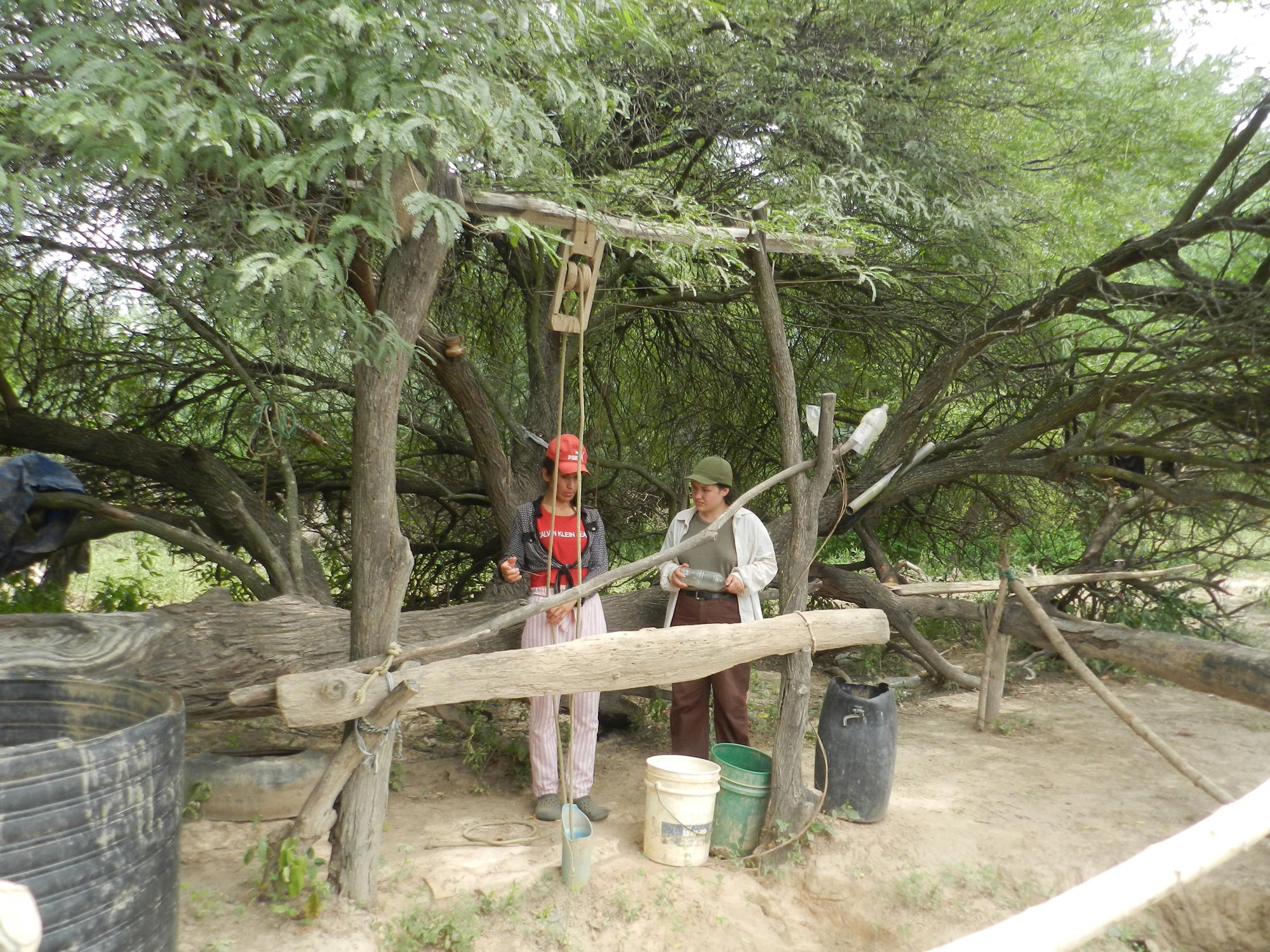 2024. Reconnaissance and sampling of a shallow well in Mistolar, Department of Boqueron, Paraguay. A Criollo resident and a student in the Human Ecology Engineering program draw water from a 16-meter-deep well during territorial reconnaissance and water-source sampling. The water is used for everyday domestic activities, but not for human consumption. Photograph: Natalia Saguer © Natalia Saguer. [Click on the image to view without the caption.]
Water as a Territorializing Force. Hydro-social territories and water justice in Mistolar
In the photograph, a Criollo resident of Mistolar and a student in the Human Ecology Engineering program draw water from a shallow well. The source is 16 meters deep and is one of the alternatives used by a family to meet its daily household needs. Although it is located near the home and can be accessed using simple technology, the water is not used for human consumption.
The scene was documented during territorial reconnaissance and water-source sampling in April 2024. Analyses recorded turbidity of 3,144 ppm (related to suspended particles) electrical conductivity of 7,010 µS/cm, and a pH of 4.6. These parameters were collected to characterize and compare sources and relate their conditions to everyday uses; they do not, by themselves, determine potability, which requires complementary chemical and microbiological analyses. The family’s differentiation among possible uses nevertheless illustrates that the presence of water does not necessarily imply the availability of water which is suitable for drinking.
Mistolar is in the department of Boquerón, in the Paraguayan Chaco, and is inhabited by Nivaclé (an Indigenous people of the Chaco belonging to the Mataco-Mataguayo linguistic family) and Criollo families (of Argentine origin, from the Salta region, who settled on the Paraguayan side of the Pilcomayo River basin in the early twentieth century). As in other settlements in the region, everyday life unfolds in an environment marked by rainfall variability, long distances, and the limited availability of permanent surface water sources. These conditions influence access to water, but they do not determine it on their own. The location of homes, the possibility of mobility, available infrastructure, and relationships built with public institutions and external organizations also play a role.
For this reason, Mistolar’s water-related challenges cannot be attributed solely to rainfall scarcity or to the environmental conditions of the Chaco. Access to water depends on the location of sources, their specific characteristics, the infrastructures that enable their use, the social distribution of access, and the resources required to keep systems operational. A single community may have water available for certain purposes while simultaneously facing persistent difficulties in securing safe water for drinking and cooking.
Water does not circulate solely through the environment. It also moves through wells, cisterns, tanks, pipes, pumps, containers, and vehicles. Its availability is shaped by families’ everyday labor, accumulated knowledge of each source, infrastructural decisions, and the relationships the community maintains with organizations and public agencies. Each of these components alters the possibilities for obtaining, storing, transporting, and using water.
This assemblage can be understood through the concept of «hydro-social territory». From this perspective, territory is not merely the physical space in which water is found; rather, it is produced through relationships between the environment, technologies, institutions, forms of knowledge, social practices, and decisions that organize water access and distribution. Water and society are mutually constituted: the conditions of water sources shape household practices, while infrastructure, norms, and forms of organization reconfigure the ways in which water circulates through the territory.
In Mistolar, families articulate multiple sources in response to differentiated needs. Depending on its characteristics, available water may be allocated to drinking, food preparation, hygiene, cleaning, or animals. Rainfall temporarily modifies possibilities for collection and storage, whereas dry periods increase dependence on alternative sources, water transport, or infrastructure which requires maintenance. The capacity to combine alternatives is therefore crucial, since no single source necessarily satisfies all uses throughout the year.
This combination forms part of a hydro-social gradient. Households are not simply included in or excluded from a supply system. They may have access to a nearby well for cleaning, rely on stored water for cooking, and need to travel or receive external support to obtain water intended for consumption. These circumstances vary according to seasonality, the condition of infrastructure, and the resources available to each household. Attending to this gradient makes it possible to move beyond classifications based solely on the presence or absence of a well, tank, or distribution system.
Each of these solutions incorporates new relationships and dependencies. A tank depends on the availability of water to fill it. A pump needs energy, repairs, and spare parts. A distribution system requires agreements about its use and upkeep. Transporting water involves vehicles, fuel, time, and labor. When any of these components fails, the consequences are not distributed in the same way: families with fewer resources, without means of transport, or located farther from water sources may face greater difficulties.
Water systems also connect the community to decisions made beyond the territory. Projects, public investments, and interventions by different organizations determine which technologies are installed, where they are located, and which problems they are intended to address. Yet a technically appropriate solution may lose effectiveness when it fails to account for conditions of use, local capacities for maintenance, or the knowledge families hold about water and territory. Installing infrastructure is therefore only one moment in a broader process that must include management, monitoring, repair, and adaptation.
It is at this point that the question of water justice becomes central. The issue is not only how much water exists or how many infrastructure systems have been installed, but also how access, benefits, responsibilities, and the consequences of system failures are distributed. Water justice includes a distributive dimension, but it also requires recognition of the knowledge and needs of different groups, meaningful participation in decision-making, and the creation of conditions that allow systems to be sustained over time.
Who has access to sufficient and safe water? Who decides where a well is built or a tank is installed? What knowledge is considered when solutions are designed? Who is responsible for maintenance? What happens when a pump stops working or a family lacks the means to transport water? These questions show that water inequalities also appear in the capacity to decide, to obtain information about the quality of sources, and to respond when systems stop functioning.
The photograph also makes visible another dimension of hydro-social territory: the production of knowledge. The act of drawing water brings together, in a single localized practice, the experience of a local resident and the work of a student. Local knowledge enables the identification of the source, its uses, and its limitations. Sampling contributes information about its physicochemical characteristics. Neither form of knowledge is sufficient by itself; their articulation allows for a more precise understanding of the actual conditions of water access and helps prevent solutions from being designed exclusively according to external criteria.
This collaborative production of information can also broaden the conditions for participation. Knowing the differences between sources makes it possible to deliberate on the uses for which they are appropriate, the alternatives that need to be strengthened, and the areas where investments should be prioritized. Technical analyses therefore acquire territorial significance when they are connected to everyday experience, practices of care, and the priorities expressed by the population. The task is not merely to measure water, but to generate information that is useful for collective decision-making.
Approaching Mistolar from the perspective of Human Ecology entails recognizing these relationships. Families are not passive recipients of scarcity. They differentiate among sources, assign uses, adapt their practices, and develop strategies to respond to changing conditions. These responses constitute localized forms of water management and life-sustaining practice. However, they unfold within material, territorial, and institutional constraints that cannot be overcome through community effort alone.
Guaranteeing the right to water requires moving beyond responses centered exclusively on the installation of technologies. It entails understanding the ecological conditions of each source, recognizing the population’s knowledge and practices, ensuring meaningful participation in decision-making, and anticipating how systems will be sustained after projects have ended. It also requires institutions to assume ongoing responsibilities and for solutions to remain adaptable to the territory’s environmental and social transformations.
Mistolar shows that talking about water also means talking about territory. A nearby well may facilitate certain uses and, at the same time, be insufficient to meet a fundamental need such as human consumption. Understanding this difference is the first step toward building solutions that not only bring water closer, but also contribute to fairer, safer, and more sustainable access.
Federico Vargas Lehner is a faculty researcher at the Faculty of Agricultural Sciences of the National University of Asunción, in Paraguay. His work focuses on Human Ecology and Agroecology, with an emphasis on socioecological systems, community water management, Indigenous territorialities, and collaborative research processes in the Paraguayan Chaco. Previously, he has collaborated at the Virtual Museum of Human Ecology as co-author of the temporary exhibition Human Ecology in Paraguay and its contribution to rural development (in Spanish) in 2019 and with the Work of the month Family farming in Paraguay and its relationship with nature in 2020.
Further reading
Linton J, Budds J. 2014. The hydrosocial cycle: Defining and mobilizing a relational-dialectical approach to water. Geoforum, 57: 170-180.
Boelens R, Perreault T, Vos J (eds.). 2018. Water Justice. Cambridge University Press.
Vargas F, Poupeau F. 2026. Gobernanza comunitaria del agua y justicia socioecológica en el Pilcomayo: un análisis comparativo desde la Ecología Humana. Anais do 64º Congresso da SOBER e XVI Congresso Mundial de Sociologia Rural (IRSA).
Vargas F, Poupeau F. 2026. “Community water governance and socio-ecological justice in the Pilcomayo: a comparative analysis from Human Ecology”. Anais do 64º Congresso da SOBER e XVI Congresso Mundial de Sociologia Rural (IRSA).