

December 2025 / January 2026
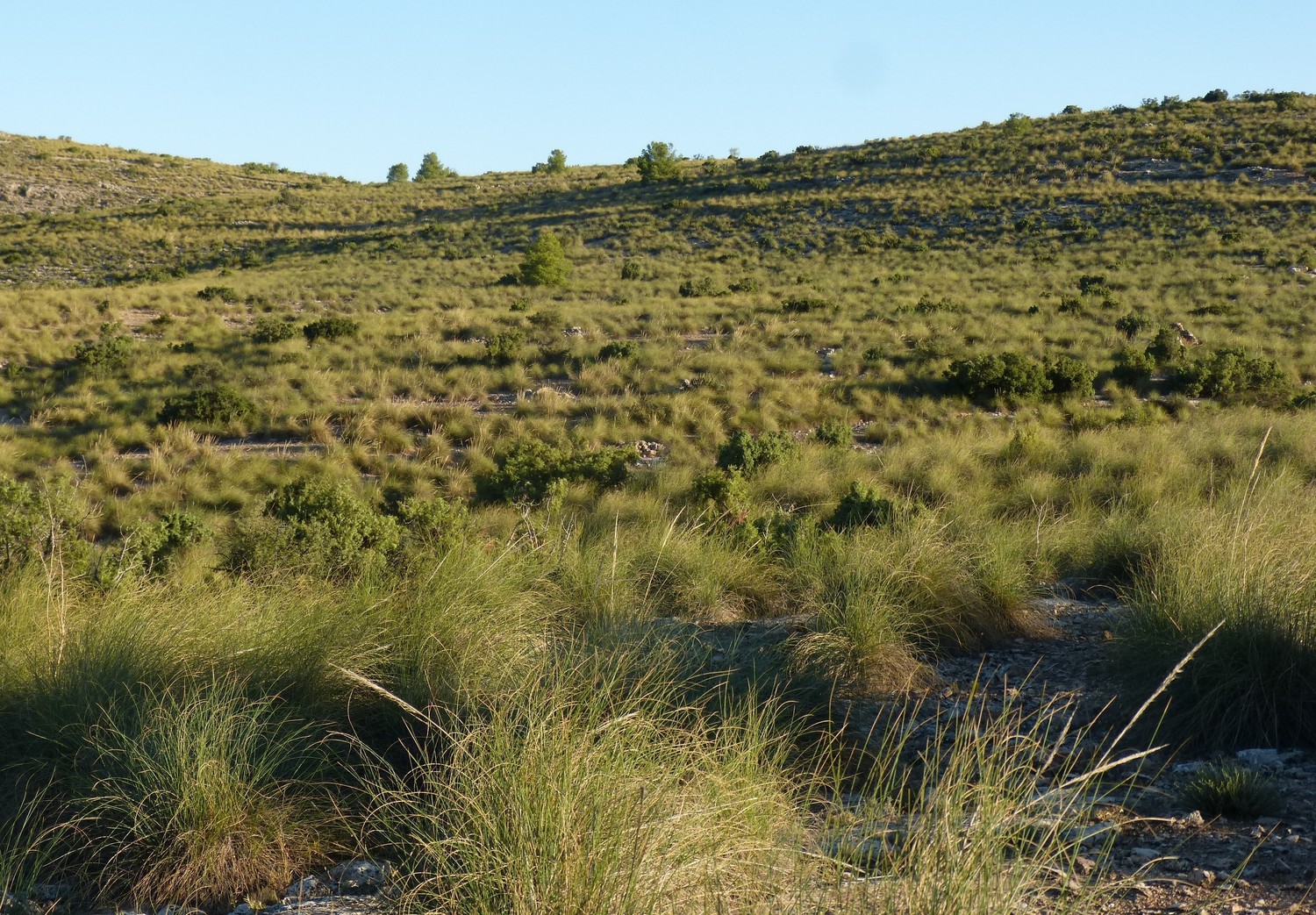 2017. An esparto field next to the Cañada Real de los Serranos, Solana del Cerro Espartosilla, Sierra de Montearagón, Casas de Juan Núñez (Albacete, Spain). Photo by José Fajardo Rodríguez © José Fajardo Rodríguez
The esparto landscape
Although there are various plant species which are known as esparto, in this case we are talking about Stipa tenacissima, a true indigenous grass to the western Mediterranean, found in the iberian-maghreb regions which stretch from the Iberian Peninsula to Libya, reaching the north of the Sahara Desert.
In the Iberian Peninsula, esparto grows as part of Mediterranean scrubland in dry, sunny areas, or in clusters where it is dominant, known as esparto fields, espartales, atochares or atochales. The largest surface can be found in the southeast quarter of Spain, in Albacete, Murcia, Almería, Granada, Jaén or Alicante, a region the Romans called Campus Spartarius, the land of esparto, the Spartarion Pedion of Strabo, crossed by the Vía Augusta. It is mainly found in limestone terrain exposed to the sun and on poor often thin soils.
Archaeological evidence of the use of esparto dates back, about 12,500 years ago, which is when esparto rope found in the Santa Maria caves in Valencia has been dated, although even more surprising are the wonderful baskets from the Cueva de los Murciélagos de Albuñol, in Granada, exquisitely crafted and about 9,500 years old (Mesolithic). The remains of charred esparto, prints on pottery and works also appear among the Argaric villages, Iberian, Roman and Andalusi archaeological sites. Preserved in very good condition in Cartagena, the Roman Cartago Spartaria, we find esparto basketwork from the Roman mines in the region. Since those baskets from Granada —the oldest remains of baskets found in Europe, with locks of hair and poppy capsules— esparto basketwork has been an uninterrupted body of knowledge to the present day, kept alive by hundreds of generations of people who were the bearers and custodians of such knowhow.
In the 1980s, the Swiss researcher Bignia Kuoni neatly named this body of traditional knowledge «the esparto culture», which in 2019 was declared in Spain as a representative list of the Intangible Cultural Heritage.
Ever since Prehistory, the use and management of esparto fields have shaped a cultural landscape which has favoured esparto and eliminated other plants, growing esparto by selecting and looking after plants for the quality and length of their fibres, so we can talk about a real process of domestication here in the Iberian Peninsula. The first references to esparto plantations can be found in the writings of Varro (117-27 BCE) in his work Res Rustica, where he recommends planting esparto on farms so as to have raw material for cordage available. Varro also states, contrary to Pliny, that it is not a wild plant. The first esparto traders were Greek and Phoenician, but exploiting the raw material was the work of the local people who managed the esparto fields. This first increase in demand, which continued with the Carthaginians and Romans, may be the origin of the gradual domestication of the plant. Unlike other plants, archaeological remains do not allow us to know whether the material came from plantations or from wild plants, so it is difficult to establish the date of domestication.
El Servicio del Esparto, a research centre which depended on the Ministry of Agriculture, operated from 1948 to 1960, in the middle of the Spanish autarchy. It published several studies of the plant, and had fields for experimenting in the town of Hellín (Albacete), a key location in the esparto landscape. With different moments of boom and fall throughout its history, the appearance of other materials like jute and the general use of plastic in the late 1960s and early 1970s brought about the decline of the esparto fibre, until then one of the most valuable natural resources of the Spanish economy.
The uses of esparto include a wide range, from basketwork, agriculture, shepherding, domestic use, fishing, etc… to the making of paper pulp, cordage and sacks. The use of esparto continues in the manufacture of plaster and cordage, while leisure esparto basketwork is growing in popularity thanks to the many clubs which are appearing in different parts of Spain. Working with esparto is therapeutic, improves psychomotricity, manual dexterity and communication when braiding in a group, in a circle, remembering a group sat round a fire.
These esparto fields, like the one in the photo ilustrating this Work of the month, located in the sierra de Montearagón, near Chinchilla in Albacete, make up a cultural, humanised landscape, the result of using and managing esparto plantations and the intensive, diverse and continuous use of esparto fibre since thousands of years ago. It is an ancestral heritage, a legacy and trace of the men and women in the esparto landscape of the southeast of the peninsula: the land of esparto.
José Fajardo Rodríguez, Ph. D. in Science and Agricultural Engineering at the Universidad de Castilla-La Mancha and professor at the Sección de Naturaleza in the Universidad Popular de Albacete, works in the field of ethnobiology, both in research and dissemination as well as in informal teaching for adults, focussing on contents such as interpreting the environment, esparto basketwork, mycology and ethnobotany.
Further reading:
Barber A, Cabrera MR y Guardiola I. 1997. Sobre la cultura de l´espart al territory valencià. Ed. Fundació Bancaixa.
Kuoni B. 2003. Cestería tradicional ibérica. Ed. Del aguazul.