

April 2025
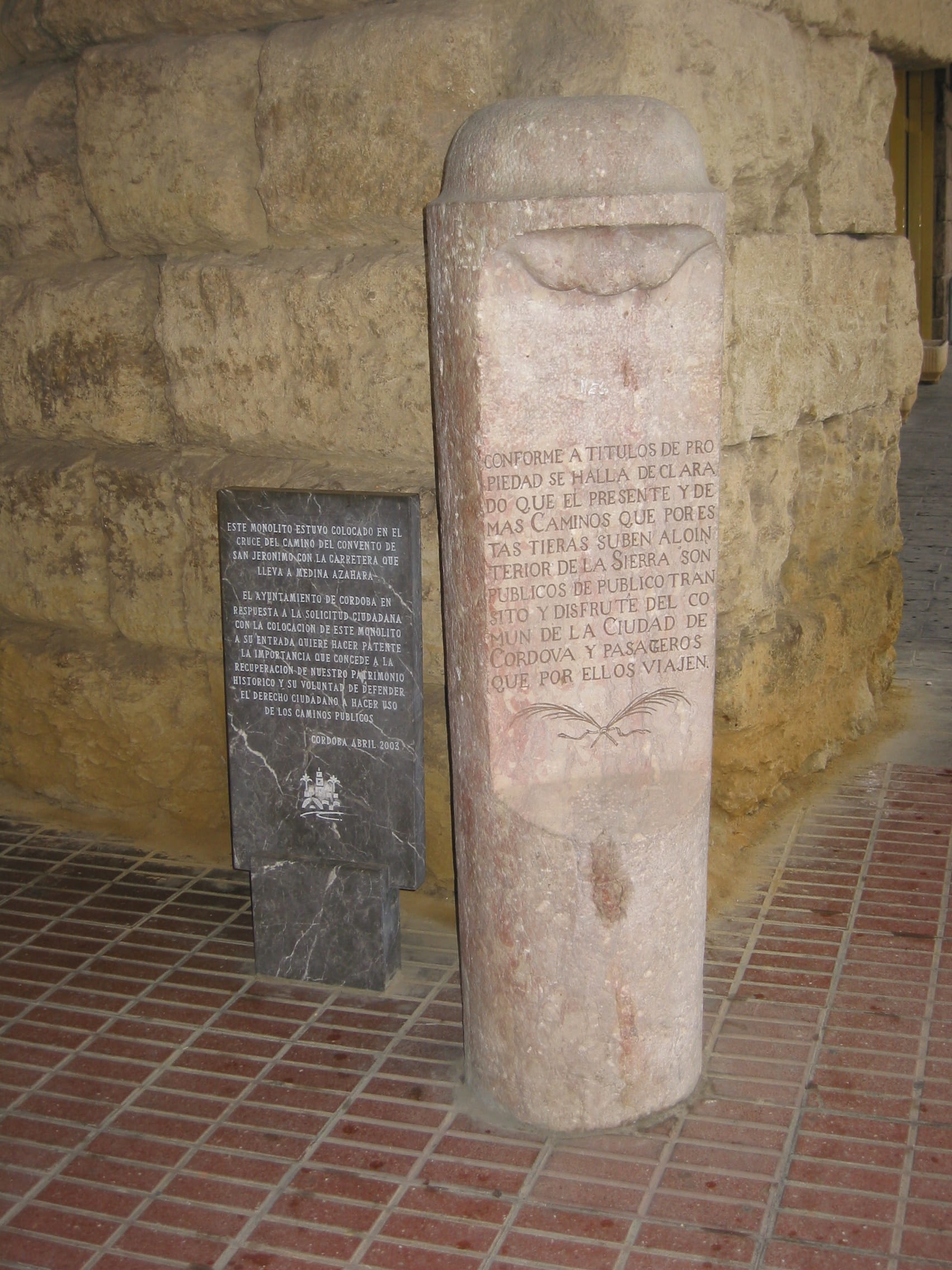 2003.On the right, monolith from 1789 at the crossing of the Monasterio de San Jerónimo (Granada, Spain) located near Medina Azahara;; on the left, monolith of Córdoba Town Hall to commemorate its recovery and installation at the entrance to the Town Hall on 20 May 2003. The text on the monolith reads: «IN ACCORDANCE WITH THE TITLE DEEDS IT HAS BEEN DECLARED THAT THIS AND OTHER PATHS WHICH LEAD THROUGH THESE LANDS UP INTO THE MOUNTAINS ARE FOR PUBLIC TRANSIT AND COMMON USE FOR THE CITY OF CORDOVA AND TRAVELLERS WHO PASS ALONG THEM.» © Plataforma «A Desalambrar»
Public paths: threats to a basic heritage of our history and our present
Paths have been an essential element of human history. Without them, communication between settlements, cultural commercial exchanges and moving livestock would have been impossible. Transhumance: an ancient practice declared Intangible Human Cultural Heritage by UNESCO deserves a special mention, as for years it shaped territory, economy and lifestyle.
The 20th century saw the spread of roads and the mass use of cars, which relegated traditional paths to a secondary role. They were seen as relics of the past, unnecessary, and their neglect led to abandonment and, frequently, usurpation. Many landowners whose properties were crossed by public paths stopped considering them as a necessary means of access and began to see them as an inconvenience. Thinking changed: it was no longer the path which led to the house but rather the private road to the closed gate, accessible only to the few.
However, now into the 21st century, with an ever more urban and sedentary society, many people have discovered the need for paths as a way to connect with nature. Hiking—a modern term for an activity as ancient as walking—has given a leading role back to paths. They may no longer be the fastest way to connect settlements, but they are still a privileged way of meeting people: they allow you to make friends, meet other people and enjoy the surroundings while you walk.
The problem for those who want to walk them is that they find many paths have been abandoned, have become impassable or have been transformed. Some have been tarmacked over, others have been cut short by housing estates, reservoirs or motorways; and many have simply been privatised by those who have appropriated something public.
Public paths are mostly the remit of borough councils, except for livestock trails—traditionally used for moving cattle—whose management depends on autonomous communities. However, in many cases, both institutions have neglected their responsibilities. They don’t even know exactly which paths are public and so, with a few honourable exceptions, they don’t meet their legal requirement to draw up and publish lists of paths.
Inaction in the face of illegal closure of paths is a widespread reality. They claim they lack means. In other cases, they are afraid of facing up to influential owners—big landowners, promoters, bankers or local worthies. In addition, not enough regulations are in place. Spain lacks a specific law on public paths, which leads to lengthy and expensive legal processes, which many local councils cannot afford.
But paths are not merely a means of transit, they are in themselves a historical heritage of great value. Many preserve the routes and structures of Roman, Andalusi or medieval times, as well as modern times, and are a narrative of how our territory evolved. Around them we find a valuable collection of heritage: bridges, fountains, inns, defensive towers, rest areas for livestock, chapels, crossings, monumental gates, dry stone walls…, elements with centuries—sometimes millennia—of history which should be preserved and protected.
Like contemporary Don Quixotes, many people all over Spain stand up to the usurpers and, sometimes, to the very administration which should be helping them. They lodge complaints, organise demonstrations, and risk legal processes, fines or losing money. They are not defending their private interest but common property; they are not protecting private property but a collective heritage which belongs to everybody.
One emblematic example is that of Felipe Ferreiro (died 2025), who devoted his life to defend the historical Venta de la Inés (Ines’s Inn), located on the old Royal Camino between Córdoba and Toledo, which appears in the novels of Cervantes. His struggle—narrated in person in Alberto Almansa’s documentary La Venta de la Inés (una zalagarda) (Ines’s Inn, an ambush)—not only attempted to preserve an historic building but also to keep the paths to it open as places to meet and of harmony. He also defended the public nature of water against the private appropriation of streams, and opposed the restrictions on accessing cultural heritage like the cave paintings in Arroyo de la Ventilla.
Another example of this struggle is the recovery of the monolith at the crossing of the Monastery of San Jerónimo, which was located near Medina Azahara (Córdoba) and illustrates this Work of the month. Dated 1789, it disappeared in 1992 and was later found by chance inside the Real Monasterio de San Jerónimo (Granada), as narrated in Rafael Ruz’s comic. Once found, thanks to the complaints lodged by the Plataforma «A Desalambrar» (Platform «Let’s unfence»), the monolith was recovered and installed at its present site at one of the doors of Córdoba Town Hall.
La Plataforma Ibérica por los Caminos Públicos (PICP) (Iberian Platform for Public Paths) is a meeting place for individuals and collectives who defend public paths and livestock trails, promoting an open countryside with access for everyone, based on respect for and conservation of the surroundings. The PICP celebrates the Día de las Vías Pecuarias y los Caminos Públicos (Livestock Trails and Public Paths Day) on or around the date of enactment of the 1995 Livestock Roads Law. On this Day—which this year has been celebrated on 22 March—organisations from all over the country get together to organise activities to remember our right to use this heritage and the need to protect it from usurpation and attack.
Our ancestors left us these paths. Thanks to their constant use over the centuries, they took shape and consolidated into part of the landscape and our cultural identity. Future generations have the right to know and walk them. So it is essential that we protect them now.
Manuel Trujillo Carmona and Emiliana Rubio Pérez are, respectively, president of the Plataforma «A Desalambrar» and member of the governing body of PICP, and president of PICP.